
Amidst the explosion in popularity of Squid Game, there has been a hot debate about the supposedly ‘limited’ translation talent pool that cannot keep up with the surge in demand. Among my peers and LinkedIn network, most are of the view that translators are well in supply, just unwilling to take up most of these jobs for their stagnant rates. This post is not about that, as I think much has already been said on this issue.
Having become truly familiar with CAT tools only recently, I can see how they can be a great aid to a translator who knows how to harness its full potential (and I can somehow imagine someone hyping them as the solution to the problem of translator shortage.) But they are mostly applied to text-based translations, whether it is websites, code strings, books or other texts. In the realm of video, there are some existing CAT tools that support audiovisual translation — such as SDL’s Studio Subtitling app for use with Trados, or Wordbee’s SRT Translator module.
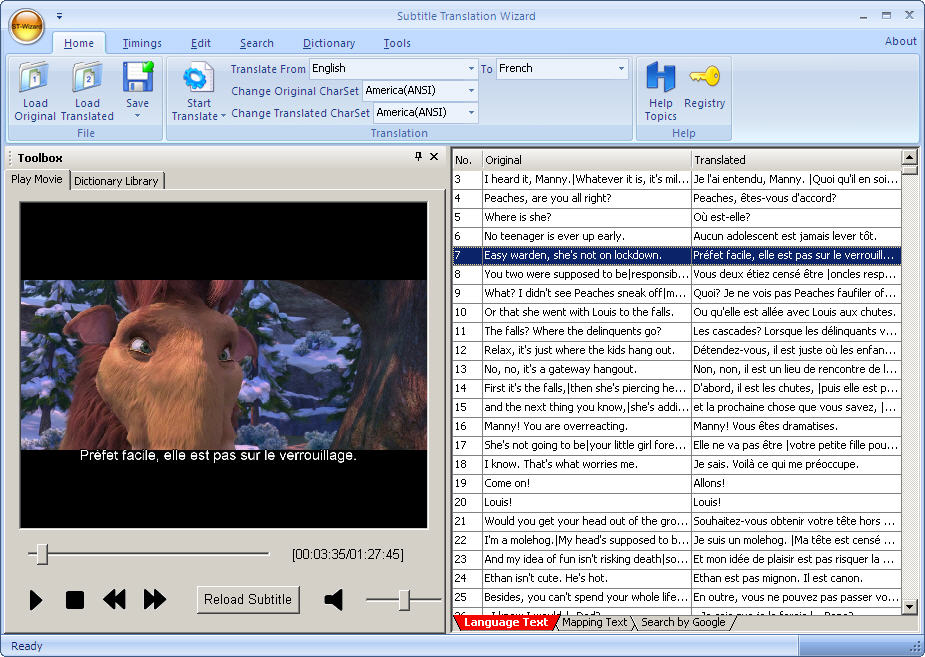
These apps are great because they allow the translator to translate in-context with a side-by-side video preview. But arguably, other subtitling tools like Aegisub or Subtitle Wizard work in similar ways, allow you to edit the translated subtitles with accompanying video. Where the CAT tools can stand out is by combining the translation memory and termbase functions with the in-video subtitle editing one.
That’s why in this post, I’m going to make the case for whether or not TM and termbase functions of CAT tools can be used in audiovisual translation.
The Typical Subtitling Process
Most translators doing audiovisual/subtitle translations work on a subtitling platform, for example one of the tools mentioned above, or proprietary tools owned by the LSP/content owner. One publicly-available example is Viki’s Subtitle Editor. Translators input the translations on each timed segment, which typically corresponds to each line of dialogue.
If subtitles in the original language has been provided, the translator can translate from there (while also considering the context of the video’s story/emotion, etc.); but if not, the translator often has to translate by deciphering the audio — which is more difficult as factors such as inaudible dialogue or interfering sounds can hinder the process. On top of that, the translator also has to keep the translation within a specific character limit per segment seconds (one guideline I’ve worked with is 20 characters per second for English subtitles), which means sometimes they have to sacrifice meaning in order to simplify and shorten the subtitle.
Termbase
For termbases, it should be quite clear that having the termbase functionality from CAT tools incorporated into your interface directly is very helpful, rather than dealing with Excel sheets of key names of characters and locations. As a translator, you have to be mindful to keep checking back on the Excel sheet to see if they have been updated; and as a QC reviewer or PM, you would also need to cross-check all terms usage manually to ensure they are consistent. An automated termbase and lookup function will be extremely useful in this case.
Translation Memory
For the uninitiated, a translation memory works like a massive brain that remembers all translations we have ever done. And every time you are working on a translation that is the same, or at least partially similar, to a translation that was previously done, the TM will remind you of what you translated it as the last time.
The first instinct for most subtitle translators would likely be to scoff and say that TMs would not work for subtitles. The biggest reason is that, unlike other translation types, subtitle translation is so dependent on context that the same dialogue could result in varying translations, depending on the different situations. Consider a simple line like, “When are you coming back?” It might be one thing to translate it literally, but a translator might also consider the emotion (sad, happy, longing), speaker (parent, child, friend, boss) and even the scenario (is the character coming home, returning to work, or back from a trip?) — which makes it hard for TM matches to be reused in a different context.
With character limits, translators may also be forced to shorten the subtitles in certain segments, which means it might not be suitable for reusing in other segments.
What’s more, consider some languages where register, formality and the lack of pronouns can complicate matches further. I’m going to talk about Chinese and Korean, which I am familiar with, but I’m sure other languages also have applicable examples.
Using the same line “When are you coming back?”, the translation can differ depending on the seniority of the speaker and the accorded speech level (formal or informal).
- Korean: 언제 돌아와 (informal) vs 언제 돌아오세요 (formal)
If you speak Korean, you would know that the two phrases above do not contain a pronoun (literally “When coming back”), where it is common in Korean to drop pronouns in sentences. It is similar in Chinese as well (“什么时候回来?” works just fine without the pronoun. This would be an issue in Chinese-to-English or Korean-to-English subtitle translation, as the translator usually has to add the pronoun or subject back into the sentence.
Does that mean the nail is in the coffin on the verdict against TMs for subtitles? Perhaps not quite. I can think of two cases where TMs might be useful.
- Videos where recurring dialogue is frequently used, usually in the same context.
- Characters who utter catchphrases throughout the drama or movie. I’d imagine if someone was translating the subtitles for Pokémon today, they could reuse TM matches for Ash’s “I choose you, Pikachu!”. Same for Bond’s “The name’s Bond. James Bond.”
- Common set-phrases in historical dramas. For example, I’ve been watching a few historical Korean dramas lately, and literally every episode, one character says to the King, “성은이 망극하옵니다” (often translated as “Thank you, Your Majesty“, but its actual meaning is “Your grace is immeasurable“. It’s a fixed phrase that was used to thank the king for any rewards or mercy, and 99% of the time the translation would be the same.
- Educational, marketing, or business presentation videos whose script was based off an existing text-based article. Translations with high fuzzy matches can usually be reused, as the context of the video is controlled in a similar situation.
The Verdict is Yours
Granted, the two cases above justifying the use of TMs are rather specific, and definitely do not apply to all, or even most audio-visual content that is translated. I do think there are some merits to use TMs with the rest of the functionalities that the CAT tools offer, like video-synchronization and termbase lookup. For now, it will depend on the judgement of the individual translator or PM to decide whether they should be used.
2 thoughts on “Furthering the subtitle debate: how can CAT Tools be used in audiovisual translation?”
Great article Min!
I also used to translate and subtitle for Viki and as a community subtitler, it definitely was difficult keeping up with characters’ names and titles and repeated phrases. I would often have to look back at the glossary, which was just a list of the terms in the discussion dashboard of Viki’s subtitle editor. I definitely agree that it made translating and subtitling difficult and cumbersome. Having some sort of termbase and translation memory for set names and phrases, respectively, would definitely be useful.
It makes sense that TMs would still be limited in AV translation, especially when it comes to short TV series or movies, because of the vast amount of characters and little repetitive dialogue. Your example of Pokemon is one exception. I can imagine the Team Rocket motto would be included in the TM, too, as it is something that is always recurring. However with constantly changing content for most shows, it’s hard to imagine a TM being a viable feature. I do see a definite use for termbase to keep track of all the important terms and names. What are your thoughts Min?
Thanks for your comment Linh! For sure, I think a working termbase is the most useful (and easily adopted) feature of CAT tools that subtitle and video translators can use. The main issue, I think, is having a CAT tool that is easy and intuitive enough for translators to pick up — such that it can be integrated in the basics that they need to learn to translate, but not having to worry about the rest of the interface. Something easier than Trados, which has so many buttons and menus that would overwhelm a first-timer.
On your point about the limited use of TMs in audiovisual translation, I think it’s similar to literary translation, where the context often changes so much that there is little point in applying TM matches.